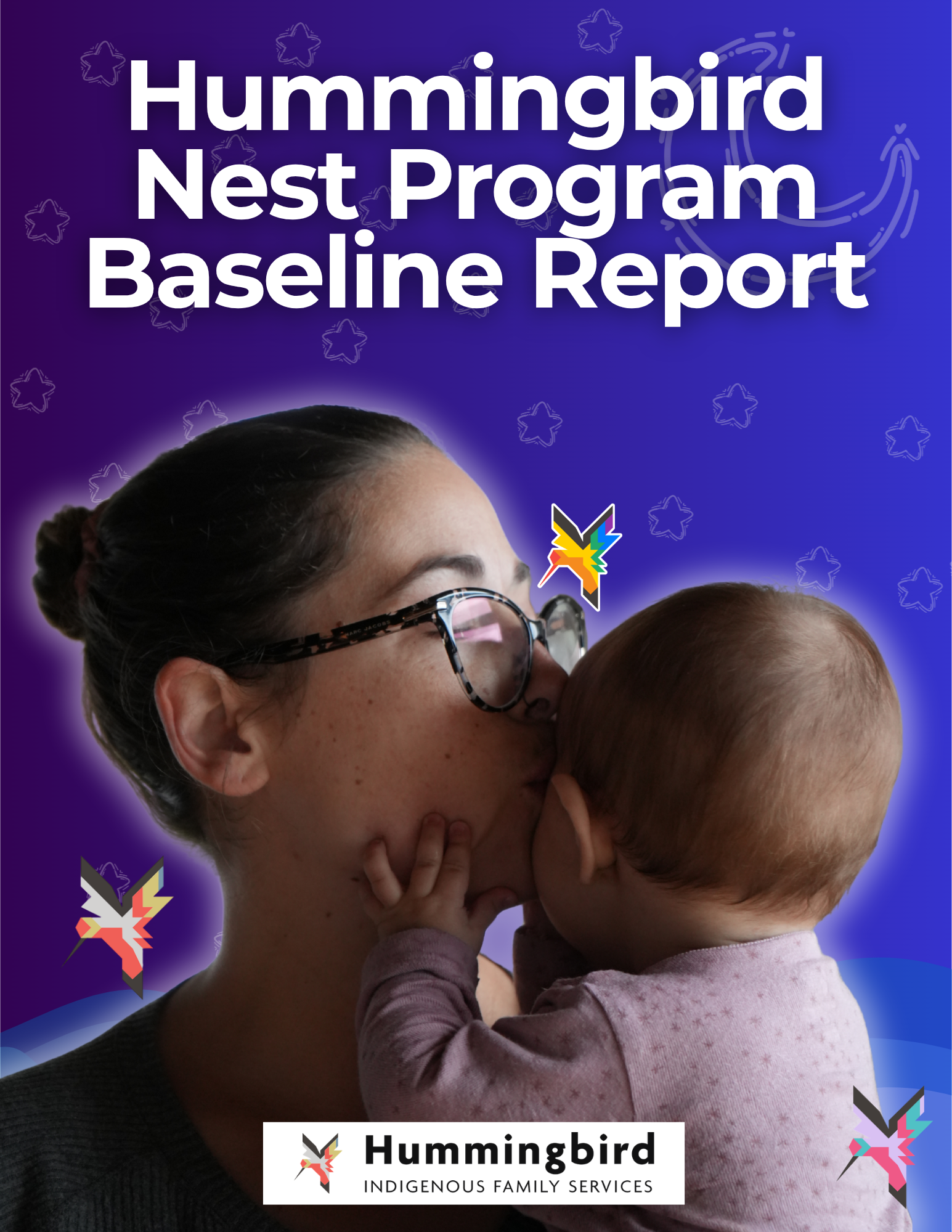
At Hummingbird Indigenous Family Services, we are committed to leading our own data and evaluation work. We believe Indigenous people should be in control of our narratives, and our all Indigenous Data Sovereignty team weaves this value into our research and evaluation work. Indigenous people’s inherent rights to reproductive and birth sovereignty extend to their data about those experiences.

So, when we think about Data Sovereignty, we think about community ownership of data, stories, and how we are represented. By embedding our research and evaluation efforts within an organization providing culturally-rooted direct services to families, we make our research and data directly accountable to Hummingbird’s mission and to the relatives we serve. This is an important step towards increasing community-driven research led by Indigenous communities. Throughout all of our projects described below, our community is our guide as we produce data for action to serve our relatives.
This is an illustriation of a Gaosali : a white flower with four petals with varied green leaves

Shaping our own narratives highlighting our community’s

beauty and wisdom

Guiding Values
Indigenous parents’ self-

determination and dignity


Reclaiming Indigenous data


Storytelling as science


Gratitude


No judgment, no experts


Love for community and one

another

Decorative quilting in logo colors
Eight point star in red
Our Projects
Nurturing Future Ancestors
The Nurturing Future Ancestors Evaluation is the data collection side of Hummingbird's Nest Guaranteed Income program. It is another way for us to learn about the experiences of families and the impacts of the Nest Program.

The purpose of Nurturing Future Ancestors is to evaluate the role of guaranteed income on family, relational, and financial wellbeing around the time of welcoming a new child into the family. We also want to learn about how cultural supports might enhance the impacts of guaranteed income.

Families who participate in Nurturing Future Ancestors are invited to participate in surveys and interviews with our Community Evaluation team several times over the course of a few years. 
Rebuilding the Village

Advancing Birth Justice Through Indigenous Knowledge

We aim to advance Indigenous evidence-based practice and policy for the benefit of Indigenous birthing families and young children by carrying out research to decrease the gap between innovative Indigenous-led programming, data production, and dissemination efforts. As we build our internal community-driven research capacity to document the impacts of its programs on birth justice in western Washington state, this grant is focused on further developing our research and evaluation efforts across Hummingbird’s direct service programs, enhancing our data-driven policy advocacy capabilities, and positioning Hummingbird to contribute to a broader national landscape of Indigenous community-led science. This project looks at how existing program data, rigorous community engagement, and Indigenous research frameworks can be used to develop a systems impact-focused evaluation plan for Hummingbird’s core service programs to assess the effects these programs are having on Indigenous health and birth justice outcomes at the individual, community, and regional/policy levels.

Pilimakua Indigenous-Led Evidence
Our Data Sovereignty and Pilimakua Family Connections departments collaborate under several grants. Our primary current project is a Research-Practice Partnership called Developing a Single-Site Home Visiting Model in an Urban Indigenous Context Using Rigorous Indigenous and Western Scientific Approaches. Indigenous home visiting is increasingly moving towards community-centered practice approaches. The next phase of this work will be driven by Indigenous best practices supported by the many insights that both Indigenous and non-Indigenous home visiting and early childhood research and practice have contributed to the field in recent decades. Hummingbird’s Pilimakua Family Connections Program and Washington State University’s Institute For Research and Education to Advance Community Health (IREACH) are excited to partner in this project aiming to advance place-based Indigenous home visiting evidence. The HIFS Pilimakua Program and IREACH share a passion for culturally-centered practice that preserves and revitalizes Indigenous practices for community wellbeing. Our organizations also share a focus on strengths-based intervention development and assessment through an Indigenous methodological lens. By bringing together a grassroots community non-profit and large university research center, we are cross-pollinating the rich resources in both settings to support a strong and successful research project that can benefit our community and yield insights more broadly across the national landscape of Indigenous home visiting. 
Perinatal Behavioral Health Care Screening Project
This pilot project is a step towards affecting local and state policy to improve behavioral health care for our Indigenous mothers and gestational parents. Our primary goal is to improve how we screen perinatal mood disorders for our community’s pregnant and postpartum people. A lack of culturally-relevant measurement tools has created gaps in identifying important care needs. To begin to address this, and with significant community input, we will reimagine, create, and pilot test a new Indigenous-specific mood disorder screening tool.  We hope this will plant the seeds for improved maternal child health for our community and beyond, and that this project will be just the first step in a bigger research effort on perinatal mental health screening and referral processes for Indigenous birthing people.
Eight point star in red
Resources & Publications
Decorative quilting in logo colors
Nest Baseline Report
Learn More

Meet Our Data Sovereignty Drum (Team)

A field of colorful wildflowers